

In pursuit of efficiency and improved customer outcomes, many firms are implementing a Product Operating Model (POM). Books such as Transformed by Marty Cagan have created a cult-like wave of POM hype and associated tools, products, and services. But is a Product Operating Model right for you?
What is an Product Operating Model?
A Product Operating Model (POM) is a style of operating model that organises a company's teams, processes, and technology around a product, aligning everyone to deliver customer value continuously and efficiently, moving from project-based work to a product-centric, lifecycle approach with empowered, cross-functional teams focused on outcomes. It bridges strategy and daily operations, ensuring alignment on customer needs, fostering innovation, and improving agility through iterative feedback-based iteration, unlike traditional structures focused on functional silos.
In the right situation, implemented well, it can
- Improve adaptability & innovation: Faster decision-making and adaptation to market changes.
- Enhance customer satisfaction: Deep focus on solving user needs.
- Increase alignment: Connects business strategy with daily execution.
- Greater efficiency: Streamlined processes and clear accountability.
The key here is in the right situation, implemented well.
Commoditised
I have been involved in the Agile movement since 2002. I saw agile emerge as something with the potential to truly deliver better products, better business outcomes, and better workplaces. Then I saw it mature and quickly become commoditised, hyped, and sold. Agile became a buzzword, and all of a sudden, Deloitte was Australia’s preeminent agile transformation firm, and McKinsey could reduce your organisations cost base by 30% with Agile.
Every executive suddenly wanted agile, and the word got generously sprinkled in strategies, mission statements, job descriptions, and executive updates. Everything was agile, and agile was needed for everything.
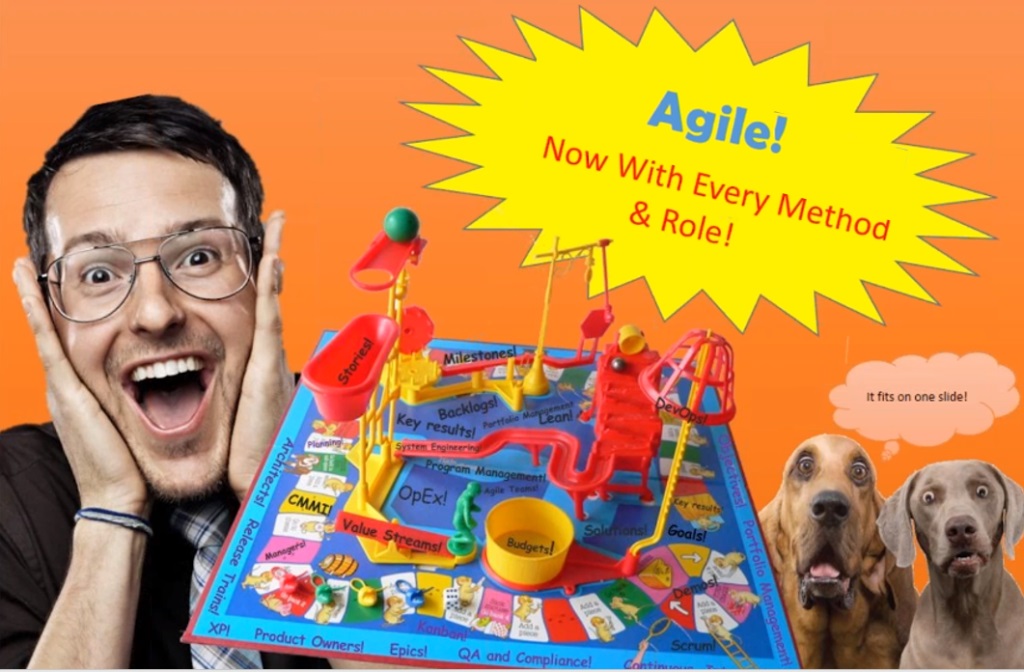
Now that everyone was “going agile”, the problem of scaling agile arose. Agile was based on small teams so now enterprises needed to know how to scale it.
And with perfect timing, along came SAFe, beautifully packaged, thoroughly detailed, one-size-fits-all solution. All you had to do was install SAFe, and you would be agile! The agile community was appalled.
Around the same time, Henrik Kniberg & Anders Ivarsson open-sourced a whitepaper, sharing how Spotify, a music streaming business they were working at, had approached agile organisational design. It quickly became known as The Spotify Model, and people started implementing it in their businesses, ignoring the explicit warning from the authors not to copy it, as it was designed for their particular businesses at a specific point in its journey.
SAFe and The Spotify Model were exactly what the large, latecomer, consulting firms wanted – a productised version of agile that could be sold to all those executives wanting a quick and easy shortcut to “go agile”. Even better, as a productised package, it could be delivered by cheap, inexperienced graduates. It didn’t matter that Spotify was the model for a streaming music startup. It didn’t matter that SAFe ignored what the business currently already had in place. Suddenly, agile could be everywhere and everyone could be an Agile Coach.
Agile was finally compatible with the Big Consulting model.
And now the same is happening with the Product Operating Model. In a similar frenzy, we are seeing organisations rush to implement a Product Operating Model without adequate consideration.
The Cookie-Cutter Trap: Structure Without Strategy
There is a certain attractiveness in copying what someone else has done. It feels less risky, because someone else has already done it, right?
Wrong. This is the trap. And every day we talk to organisations that have been burnt by this, costing millions in failed transformations, disrupted teams, and abandoned initiatives
The mistake is treating operating models as one-size-fits-all solutions. They aren't. Many organisations implementing a Product Operating Model haven't stopped to ask whether it's the right model for them.
We recently worked with a company that made this exact mistake. Over a century, they'd built a remarkable business, based on a deep, trust-based relationship with their customers. Some staff knew customers personally. Claims adjusters had the authority to make exceptions because they understood the context. Their competitive advantage wasn't product or innovation—it was intimate customer knowledge and the ability to customise solutions.
So what did they do? They implemented a Product Operating Model because that's where the industry was moving. They broke their services into “products” and around these. The structure looked right. It was what everyone else was doing.
When we asked them, "What has made you successful?" the answer wasn't "our products”. It was “understanding our customers” and “going the extra distance to serve them." They were not a product-centric company. They were a customer-centric company. A customer-focused operating model would have been far more powerful than a product-centric one.
Getting Your Strategic Foundation Right
There are many different types of operating models, with the Product Operating Model (POM) as one of them, but before you choose which operating model, you need to understand what you're trying to win at. Two simple tools that can help with this are the Playing to Win model, and the Value Disciplines model.
Playing to Win
Playing to Win frames strategy as a small set of deliberate choices about where to play and how to win. Those choices only matter if the organisation is designed to support them—through appropriate capabilities, decision rights, funding, and governance. In that sense, the operating model is what turns strategy from intent into repeatable execution.
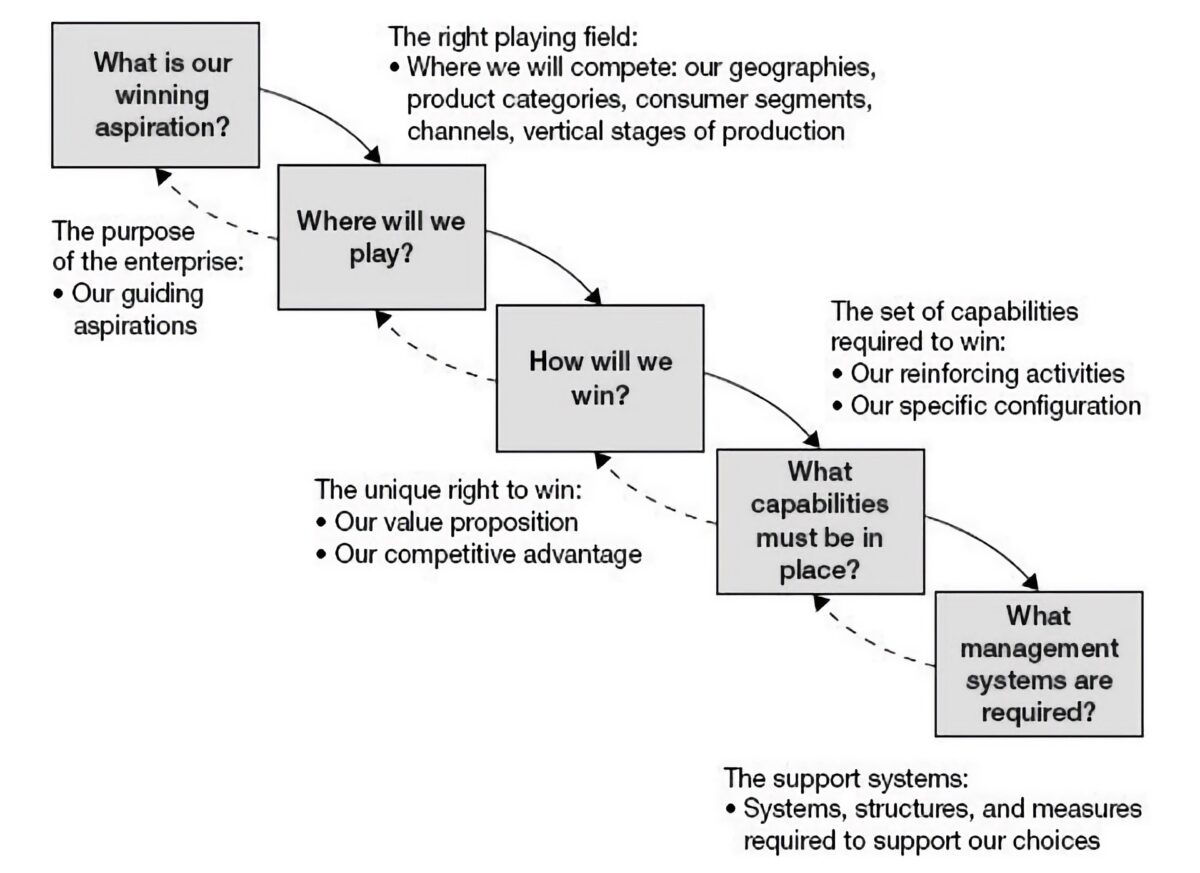
- Where do you play? What markets, customer segments, and channels define your business? What are you truly excellent at serving? The insurance company played in commercial insurance for medium-sized businesses—they'd spent a century deeply understanding that specific segment.
- How will you win? Which value discipline is your competitive advantage? Are you winning on cost? On innovation? On deep customer relationships? The insurance company's answer was crystal clear: customer intimacy. That was their moat, their defensible advantage.
- What capabilities must be in place? Only once you've answered the first two questions do you consider your operating model. If you're winning on customer intimacy, you need a model that gives frontline teams customer context and real decision-making authority. If you're winning on product innovation, you need rapid experimentation and creative autonomy. If you're winning on operational excellence, you need process discipline and cost accountability.
The mistake many organisations make is to stop at these choices and assume alignment will follow. In reality, strategy only becomes real when it is embedded into how work is structured, funded, governed, and led every day. Your operating model is therefore not a downstream design exercise — it is the mechanism that makes your where to play and how to win choices visible in the behaviour of teams and leaders.
Value Disciplines Model
Treacy and Wiersema identified three fundamental value disciplines on which organisations compete, and in working with organisations across industries, we've seen that understanding these disciplines is critical to choosing the right structure.
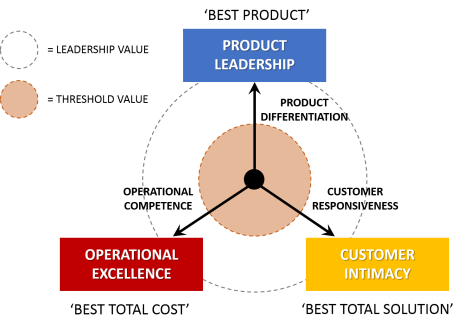
- Operational Excellence: You win by being the low-cost provider. Your operating model emphasises efficiency, process optimisation, and continuous cost reduction. Think Pak n Save, or McDonald's —companies that have structured themselves entirely around ruthless efficiency. Every process is standardised. Every cost is examined. Their entire organisation is built to execute flawlessly at scale.
- Product Leadership: You win by being first to market with the most innovative solutions. Your operating model emphasises speed, creativity, and rapid commercialisation. Apple and Tesla didn't ask for permission to break conventions; they asked for funding to experiment. Their structures prioritise R&D, rapid iteration, and freedom to fail fast.
- Customer Intimacy: You win by delivering deeply customised solutions tailored to individual customers. Your operating model emphasises relationships, empowered decision-making at the frontline, and flexibility. At Radically, we have built our entire business around understanding what individual customers need. Our team have the authority to make decisions because they understand the customer context better than anyone else.
The key point is that you cannot excel at all three.
The resources, processes, incentives, and cultures that make you brilliant at one actively work against excellence in the others. You have to choose. And once you've chosen, your operating model must be designed specifically to support it.
The critical insight of the Value Disciplines model is not the labels themselves, but the trade-offs they force. Each discipline demands fundamentally different structures, decision rights, incentives, and leadership behaviours — which means trying to pursue all three inevitably creates tension, confusion, and mediocrity. Clarity about how you win is, therefore, a prerequisite for designing an operating model that actually works.
Designing and Implementing the Operating Model
We work with organisations that recognise the importance of designing an operating model that fits their business and will optimise their ability to deliver their strategy.
This isn't about implementing a predefined model. It's about undertaking the complex heavy lifting of deeply understanding the organisation—the history, market, people, and capabilities—making strategic choices and then co-creating an operating model that flows from that understanding.
This involves a holistic redesign of the
- Governance: the framework to plan and prioritise work, translating organisational strategy into a clear cadence of objectives, goals, and delivery plans that align day-to-day activity with desired outcomes.
- Structure: In an operating model, organisational structure defines how work is divided, coordinated, and governed so that people and responsibilities are aligned to deliver the organisation’s strategy and value proposition.
- Leadership & Culture: the behaviours, values, and practices modelled by leaders and adopted across the organisation, shaping the environment, mindset, and lived experience of how work gets done.
- Ways Of Working: the practices, processes, methodologies, and behaviours that define how work is planned, executed, and managed, creating clarity and consistency in how people collaborate, communicate, and deliver organisational goals.
- Future Capabilities: the skills, processes, technologies, and structures an organisation must develop to enable its strategy, adapt to change, and remain competitive as market demands evolve.
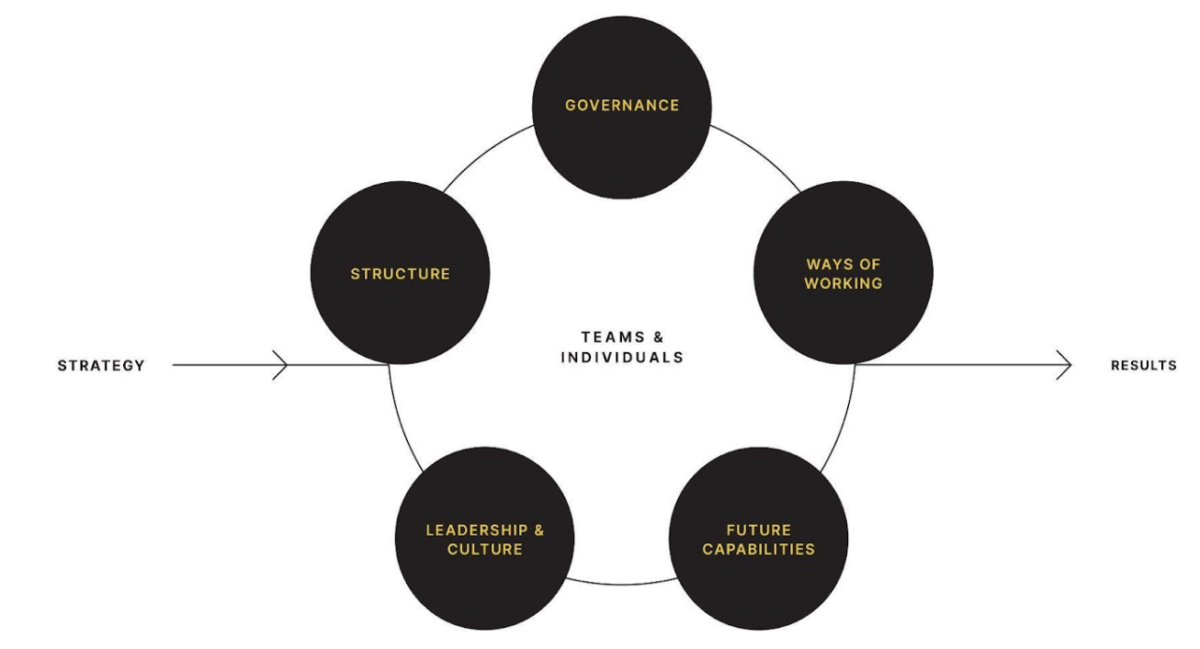
We recently worked with a large Australian energy company on exactly this challenge. They needed to accelerate delivery and respond faster than competitors in an intensely competitive market. But the real work wasn't picking a framework. It was understanding their business design: where they play, what makes them unique, and how they actually win.
The result? A custom operating model built around value streams, explicitly designed for their context and strategy. Not a template. Not something copied from a tech company. Something that worked for *them*.
The outcome speaks for itself: $6M in cost savings, dramatically accelerated delivery, reduced silos, and—crucially—people who actually understood why the structure existed and how their work mattered.
That's what happens when operating model design starts with strategy, not with structure.
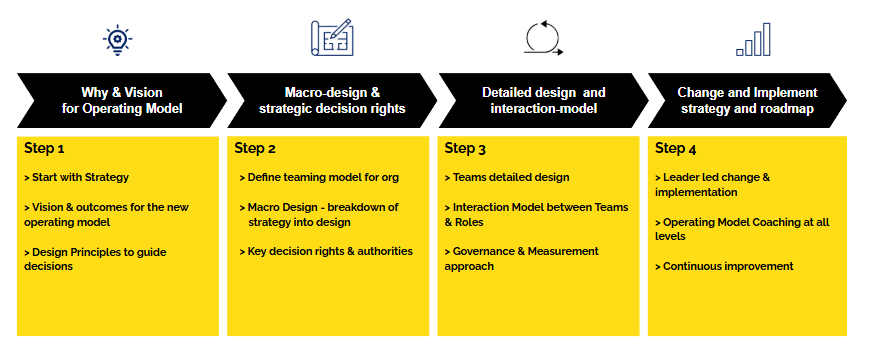
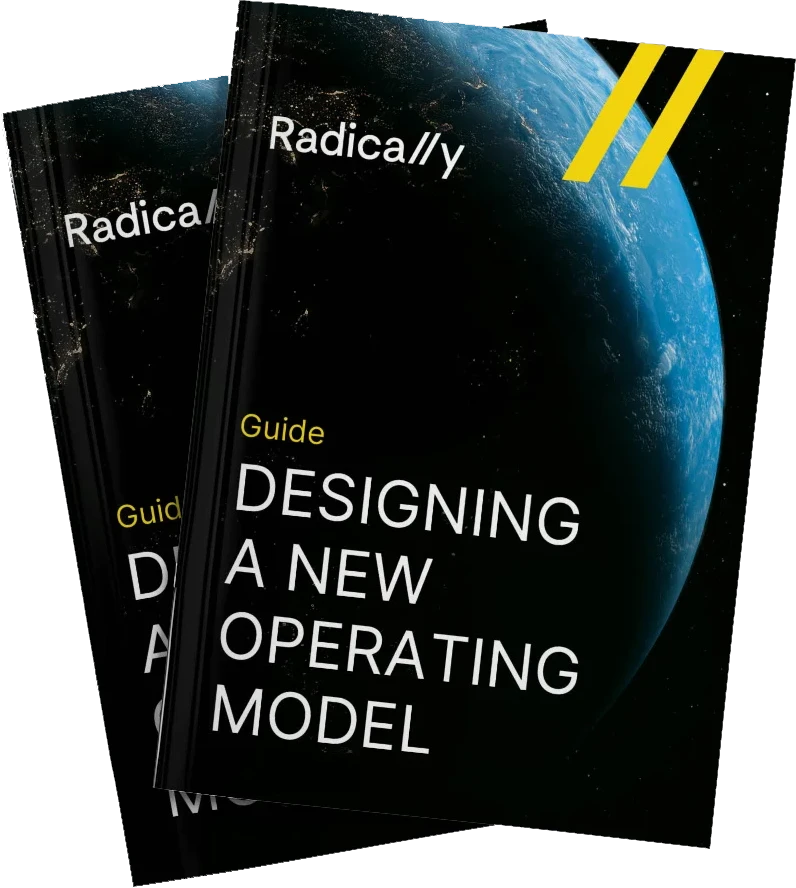
Operating Model Design
Design an operating model that drives performance without compromising on humanity. Download our free guide below.
Getting It Right
Getting your operating model right is utterly transformative. When your operating model reinforces your competitive advantage, something shifts. Strategy reaches teams. Execution becomes efficient. And your organisation moves with clarity and speed, not confusion and drift.
We've seen organisations transform when they finally align structure with strategy. Mercury and TrustPower merged two organisations with distinct cultures. Instead of imposing a template, we worked with their leadership to understand what unified success would look like—then designed an operating model to enable it. The judges called it "a masterclass in laying the right foundations for success." It won NZ Business Transformation of the Year. The judges called it "a masterclass in laying the right foundations for success." It won NZ Business Transformation of the Year.
Origin Zero faced a familiar challenge: it had a clear strategy to accelerate customer-centric energy solutions and support the transition to cleaner energy, but its existing operations — built around entrenched processes and functional silos — were slowing decision-making and limiting responsiveness to customer needs. Radically worked with Origin Zero to redesign their operating model, shifting teams into cross-functional Value Streams that reduced hand-offs, empowered teams to make faster decisions, and brought end-to-end accountability closer to the customer journey. The results were tangible: the organisation became more responsive to market changes, internal alignment improved, Value Streams became self-managing, and customer satisfaction increased as the teams were able to deliver clearer, faster, and more tailored solutions to evolving customer demands.
Summary
The Product Operating Model isn't bad. It is one of the possible operating model options to consider, once you’ve done the preparatory work.
Before you implement a model, ask: What has made us successful? What are we uniquely good at? Which value discipline is our edge?
Answer those questions first, then choose your operating model. Everything else will be faster, cheaper, and actually work.
Because the organisations that win aren't the ones that copied the best structure. They're the ones who designed a structure that reflects who they are and how they actually compete.