
The next stage of AI will force organisations to redesign teams around humans and agents working together. The people who lead those teams will need a very different set of capabilities.
AI has changed the tools people use, but not the organisation around them.
For most organisations, AI adoption is already enabling meaningful productivity gains. People have faster ways to draft, summarise and analyse, while agents are increasingly taking on discrete tasks and, in more advanced organisations, coordinating parts of a workflow. But while the work is getting faster, it’s still passing through the same teams, approval points and functional boundaries. The organisation around it isn’t changing at the same pace.
As agents move from supporting individual tasks to carrying work across end-to-end workflows, that model will reach its limit. The next stage of AI maturity will require organisations to rethink how work is divided between people and agents. Agents will take on more of the specialist roles, while people set direction, exercise judgement, navigate relationships and remain accountable for the outcome.
This changes the logic of how teams are organised, by outcomes rather than a series of functional tasks. Roles, handoffs, decisions, feedback loops and measures of performance will need to change around this new division of work.
This makes AI as great a workforce challenge as a technology one. Deploying a new tool can be led by technology, redesigning a team & uplifting capability of your people cannot. It requires leadership decisions on how work should flow, where accountability should sit, what people remain responsible for as Agents take on more of the execution, and how people upskill themselves to become more ‘T-shaped’.
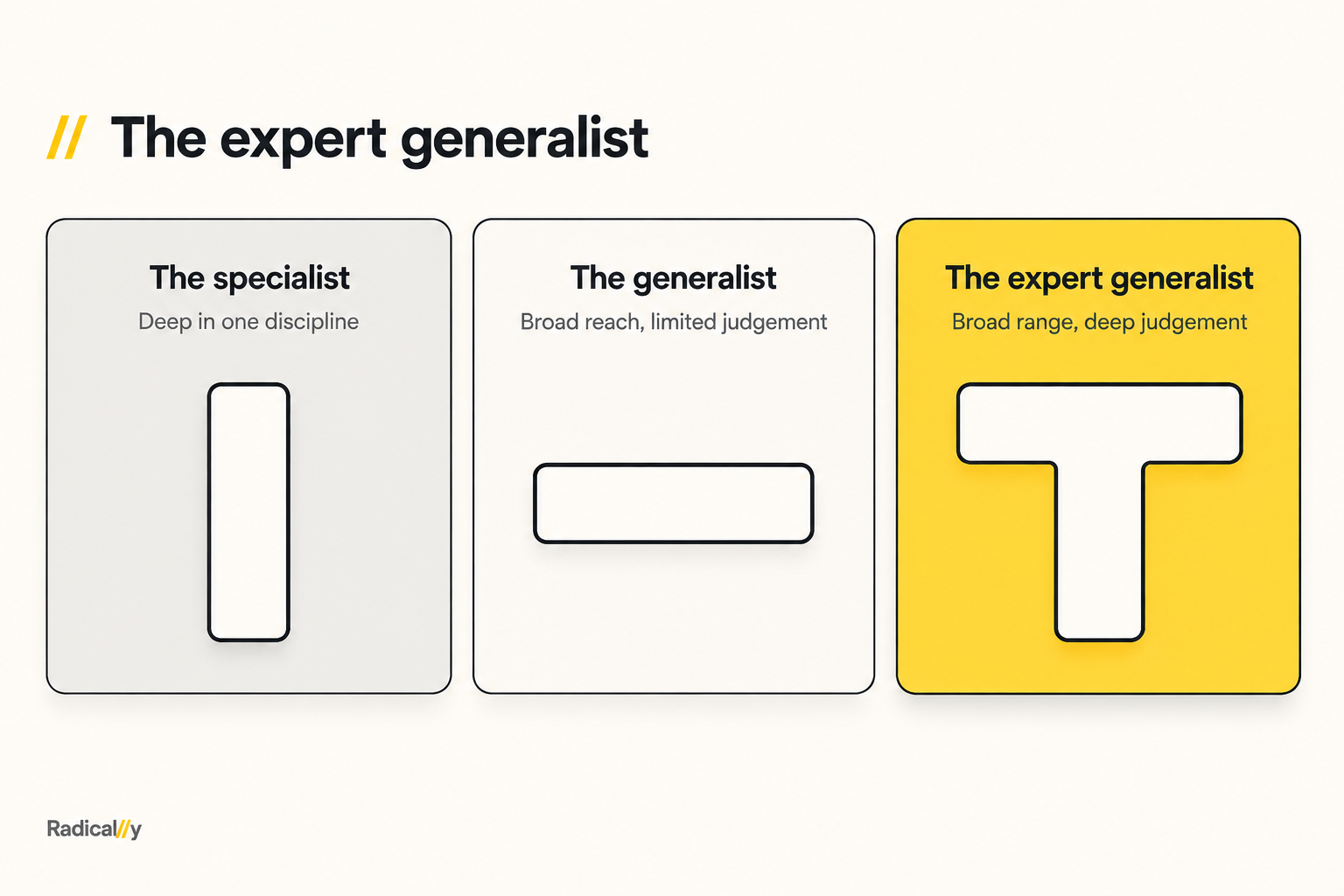
And the roles required will not map neatly to the existing org chart - teams will need people who can work across functions, direct multiple agents, judge specialist outputs and own an outcome from beginning to end. This is the emerging role of the expert generalist.
The organisations that develop this capability early will be better placed to translate AI productivity into faster decisions, lower cost to serve, and better customer outcomes. Those that focus on the tools alone risk making individual tasks faster without changing the performance of the organisation as a whole.
AI changes the economics of expertise
Most organisational structures were designed for a world where specialist knowledge was difficult and expensive to build. Work was divided by function, roles were created around narrow disciplines, and career paths rewarded people for developing greater depth in a particular area. When expertise predominantly sat with individuals, organising work around that expertise made sense.
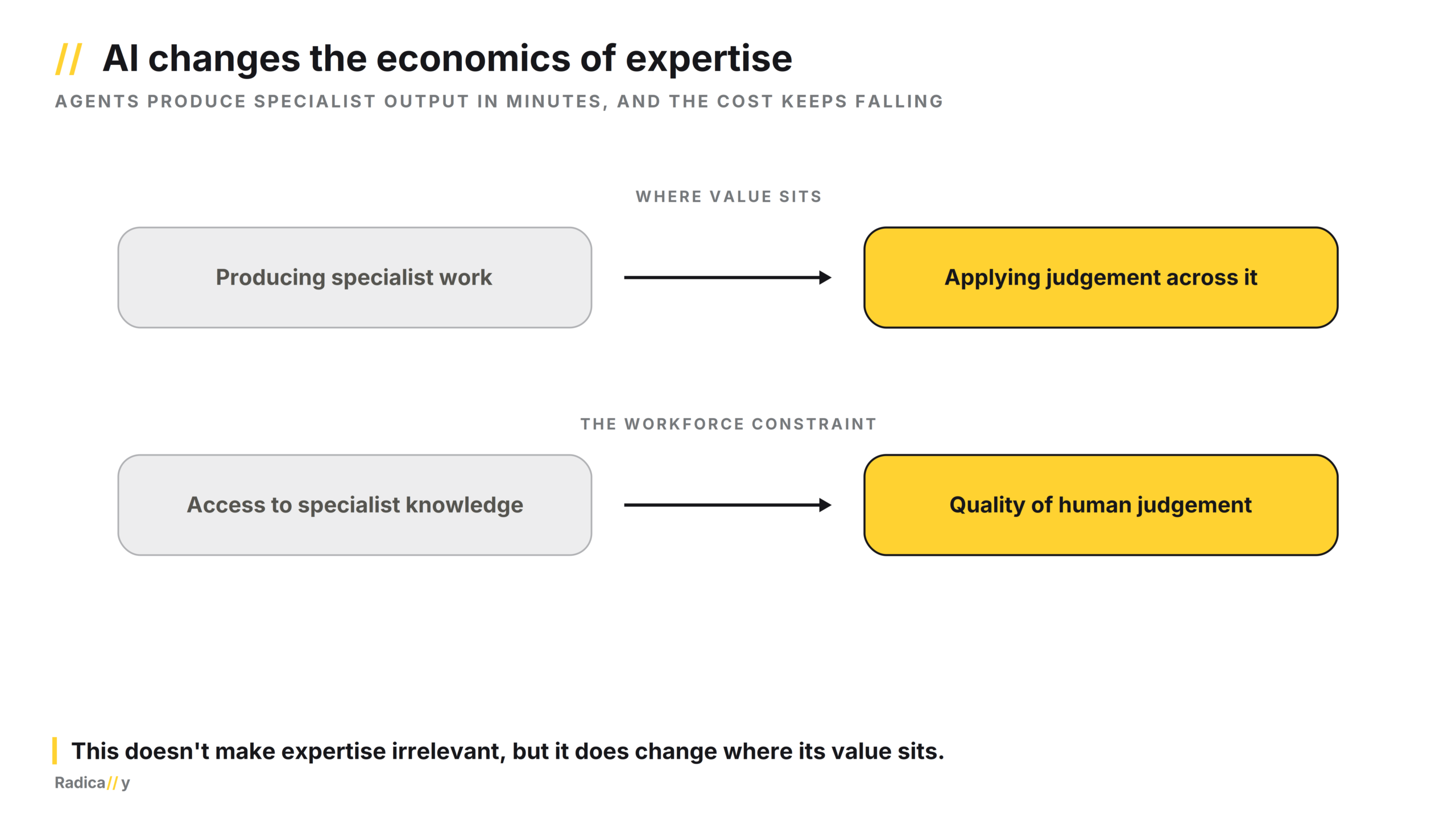
Agents are beginning to change the economics of that model. They can produce a credit analysis, review a contract, develop a campaign plan or build a financial model in minutes. Undoubtedly their capability will continue to improve, while the cost of accessing specialist knowledge will continue to fall. This doesn’t necessarily make that expertise irrelevant, but it does change where its value sits.
As the ability to produce an output of work itself becomes less scarce, the ability to direct the work, evaluate its quality and understand the consequences becomes more important. Value begins to shift from producing specialist work to applying judgement across it. Workforce constraints will shift from access to knowledge towards the quality of human judgement, and new types of roles will begin to emerge.
The specialist: deep in one discipline AI Maturity
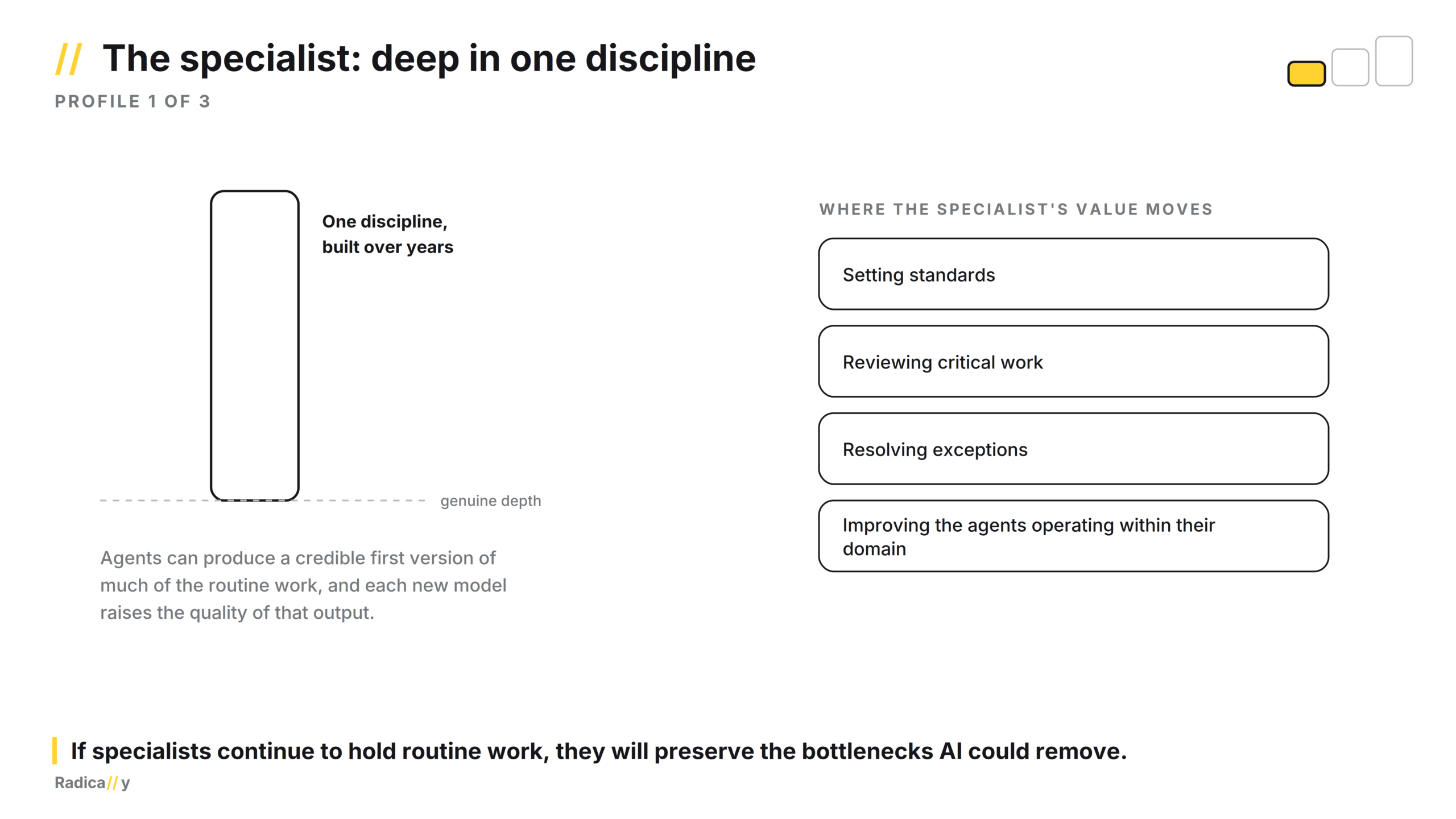
What’s happening: Specialists that have spent years building depth in a particular area, such as finance, procurement, compliance, marketing, operations now find that agents can produce a credible first version of much of their routine work, and each new model raises the quality of that output.
What it means for your organisation: Although specialist expertise remains essential, particularly for high-risk, novel or complex work, it is no longer the primary source of value. As a result, specialists will be increasingly responsible for setting standards, reviewing critical work, resolving problems and improving the agents operating within their domain. The risk here is treating production as the only expression of expertise. If specialists continue to hold routine work because existing roles and incentives reward them for producing it, they will preserve the bottlenecks that AI could remove.
The generalist: broad reach, limited judgement
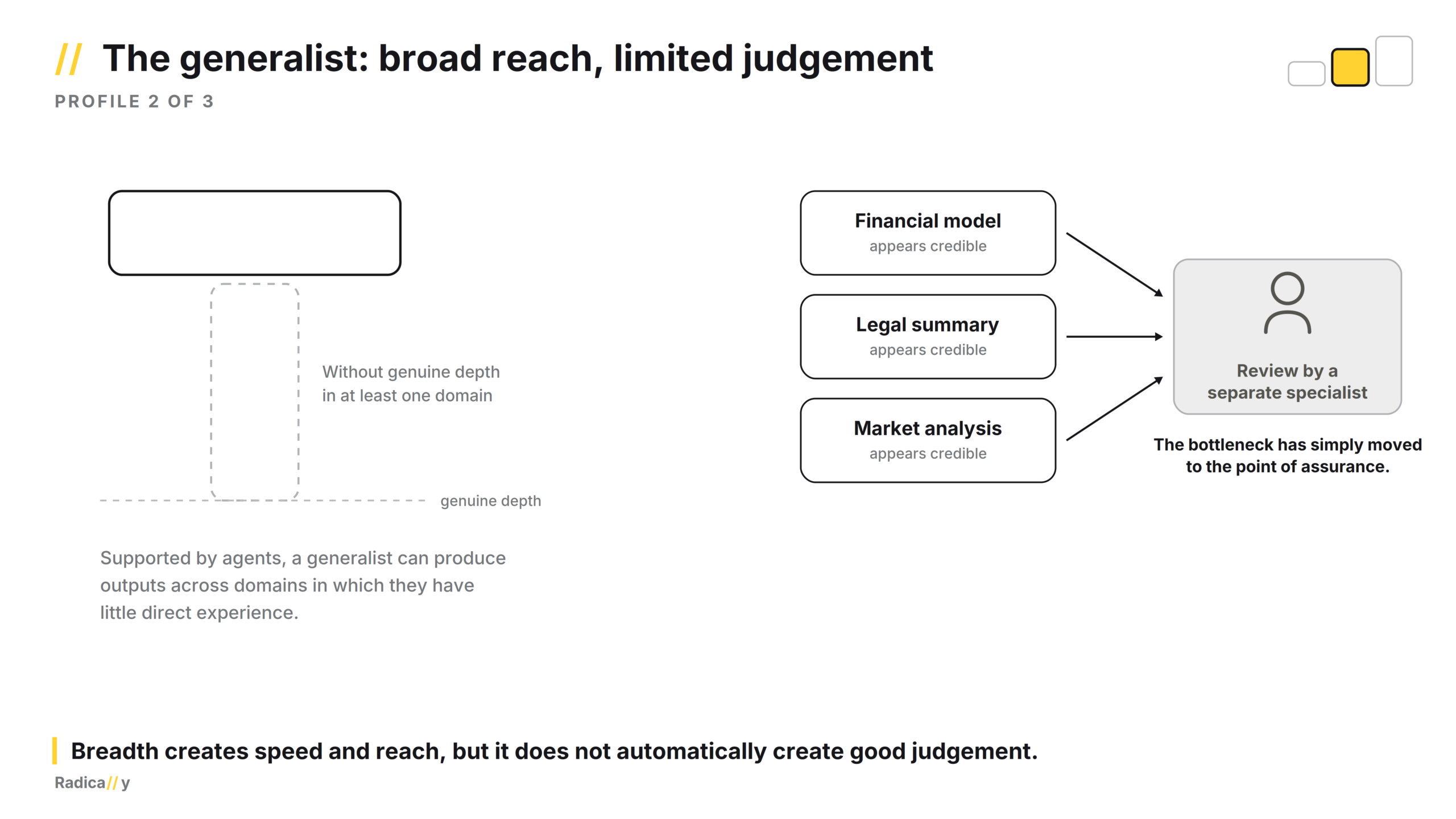
What’s happening: Generalists create value by working across functions, connecting information and maintaining a wider view of the organisation.AI now gives them access to specialist outputs they could not previously create themselves. A generalist supported by agents can develop a financial model, legal summary and market analysis across domains in which they have little direct experience. Each output can appear credible, however the risk is that underlying assumptions are wrong.
What it means for your organisation: Breadth creates speed and reach, but it does not automatically create good judgement. Without genuine depth of experience in at least one domain, a generalist may struggle to distinguish a strong answer from a plausible one. If every output still requires review by a separate specialist, the bottleneck has not been removed - it has simply moved to the point of assurance, and range of expertise alone is no longer enough.
The expert generalist: broad range, deep judgement in a vertical
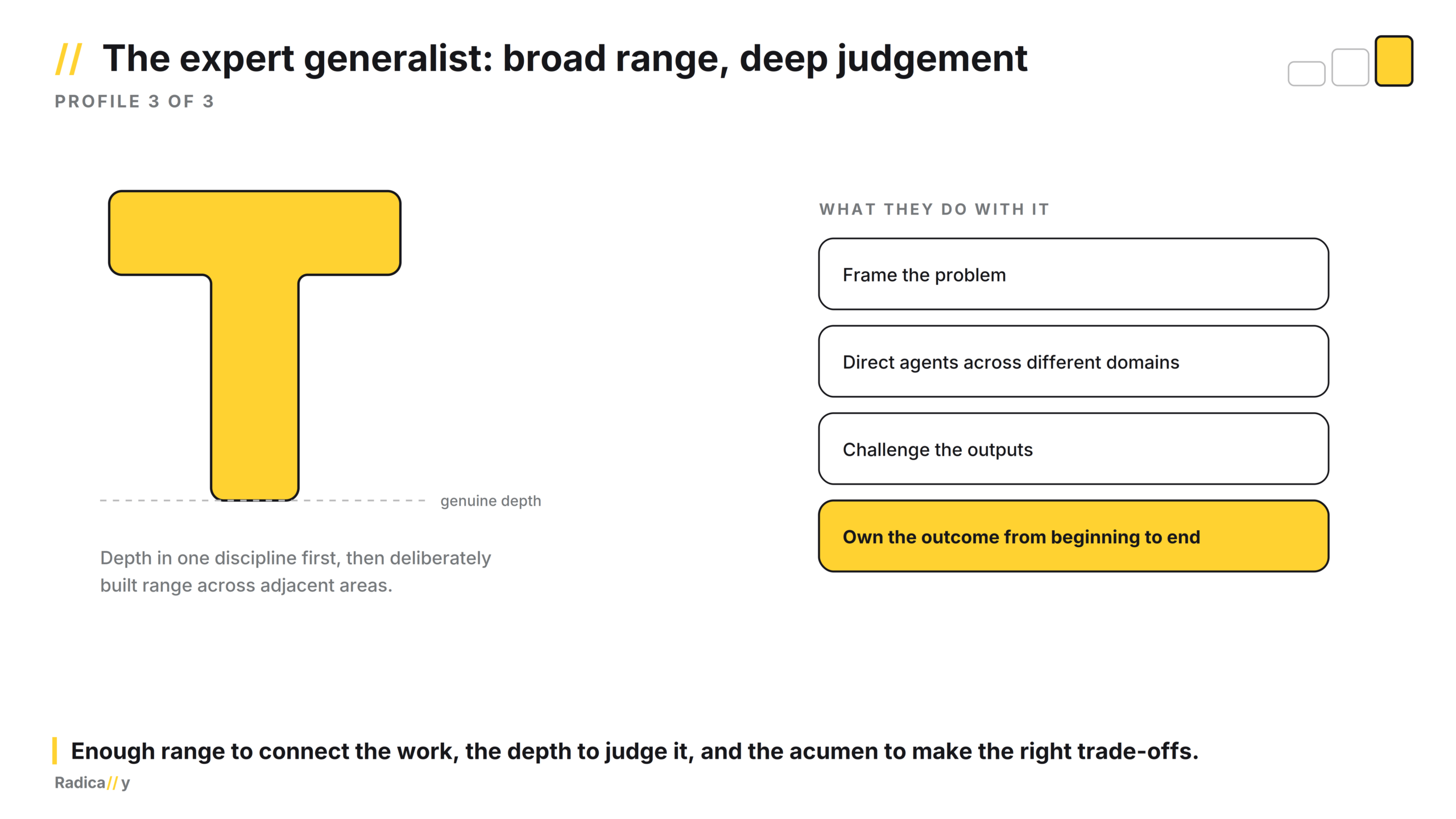
What’s happening: The expert generalist begins with depth in one discipline, then deliberately broadens their capabilities across related areas. They understand how high-quality work is produced, where it commonly fails and when deeper specialist input is required. They can frame a problem, direct agents across different domains, challenge the outputs, and integrate the work into a coherent recommendation.
An expert generalist's defining capability is end-to-end ownership.
What it means for your organisation: Expert generalists provide the link between specialist agents and business outcomes. They don’t need to complete every activity themselves, but they do need enough range to connect the work, the depth to judge it, and the business acumen to make the right trade-offs.
As agents absorb more of the clear and complicated work, people will spend more of their time navigating the complexity of decisions with no obvious right answer, competing priorities, relationships, exceptions and accountability.
The expert generalist is not simply a new job title but a capability profile that will become increasingly relevant across operations, product, customer service, marketing, finance and beyond.
The real scarcity
AI is often expected to make organisations less dependent on people. In practice, it makes building the right human capability around the technology more important than ever.
As agents absorb more of the execution, human contribution will increasingly center on direction, judgement, relationships and accountability.
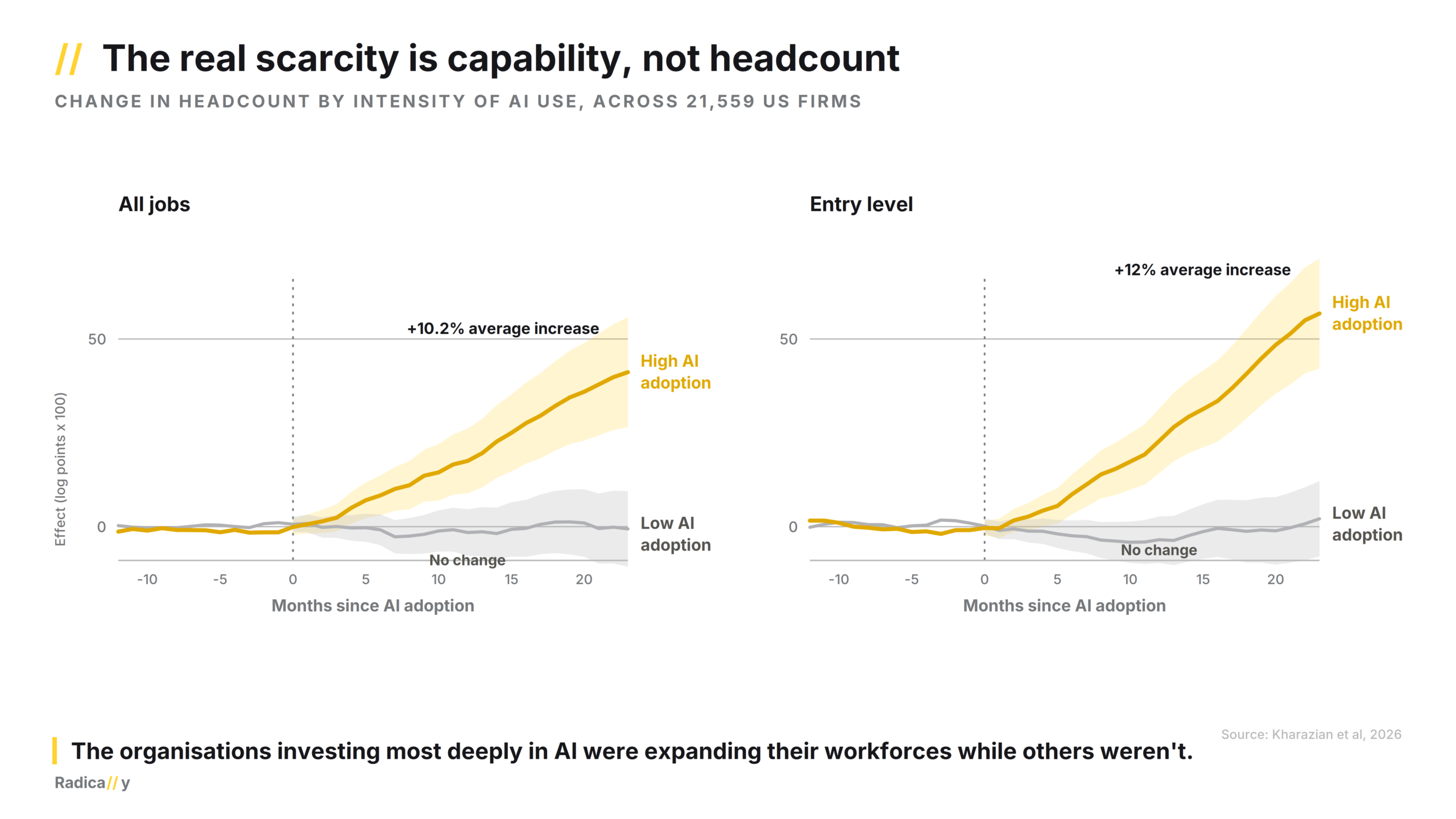
But this does not necessarily mean employment rates will fall. A 2026 study of 21,559 US firms found that companies who successfully adopted AI, grew total headcount by 10.2% over two years and entry-level headcount by 12%, while companies who failed to adopt AI saw no statistically significant change. The significance is not that AI automatically creates jobs, but that the organisations investing most deeply in AI to achieve measurable returns were expanding their workforces while others weren’t.
AI productivity can enable an organisation to serve more customers, launch more products and pursue opportunities that were previously too expensive or slow. And when that additional capacity translates into growth, demand for people can grow with it.
AI enabled Teams: Why redesigned teams need the expert generalists
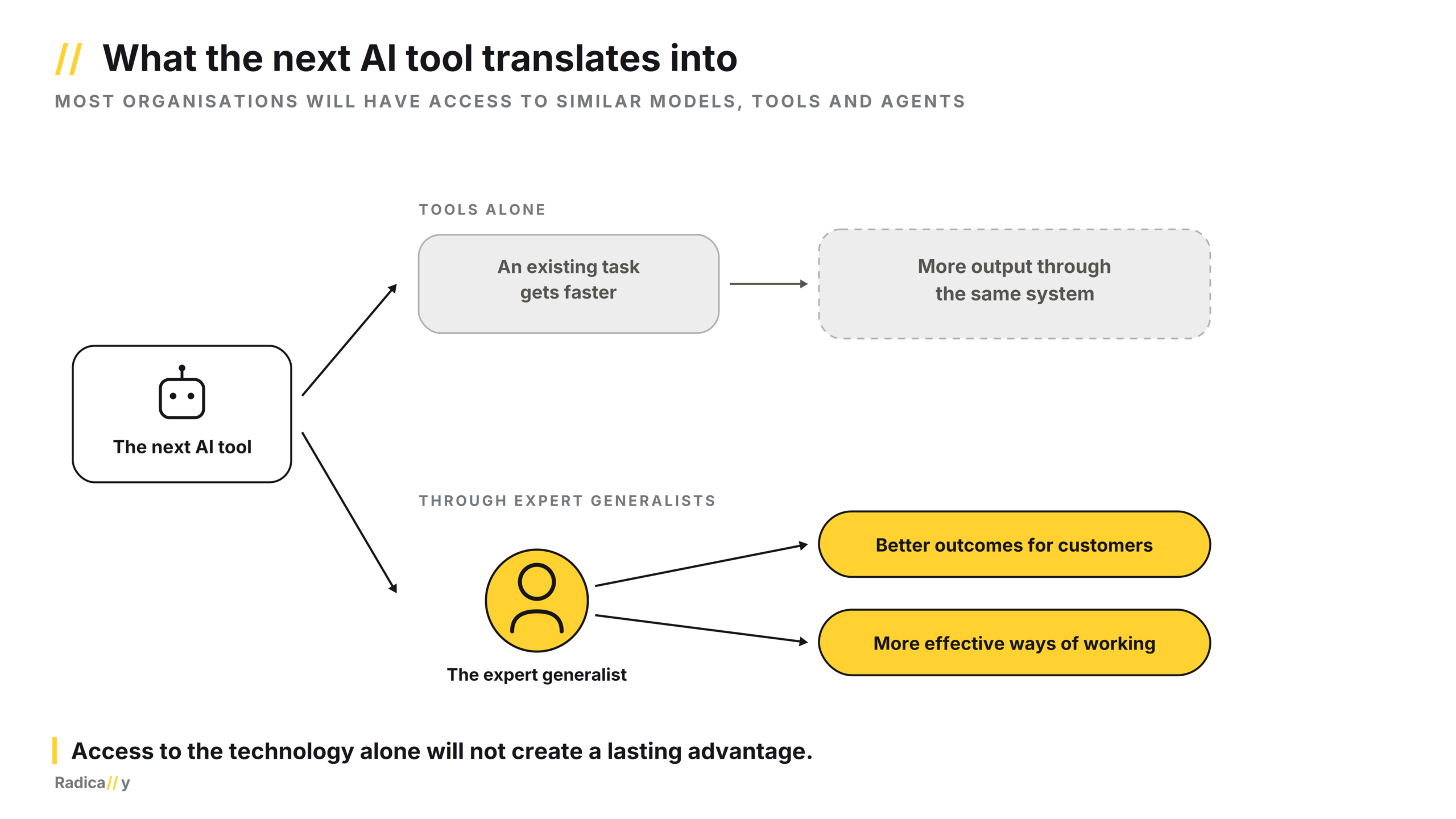
As access to advanced AI models, tools and specialist agents becomes increasingly widespread, the technology alone will not provide a lasting competitive advantage. The real competitive edge will come from redesigning work around end‑to‑end ownership, and from the quality of the people who lead it.
The next AI tool may make an existing task faster, but the expert generalists will determine whether that capability translates into better outcomes for customers, and more effective ways of working.
Most customer and business outcomes already operate across multiple functions. Launching a product may involve customer research, commercial modelling, legal review, operations, technology and marketing. Today, that work moves between specialist teams, with each responsible for its part rather than the outcome as a whole. Agents can take on that specialist work across functions but they do not remove the need for human ownership, they increase it.
A redesigned team needs someone who can set the objectives, determine what work should sit with agents and what requires people, evaluate outputs across domains and remain accountable for the result. Just as importantly, they need to know when the risk or complexity of the work calls for a human expertise.
This is why putting AI into existing roles is not enough. The value comes from redesigning the work around end-to-end ownership, then building the capability to operate across this new system. Without that change, organisations are likely to deploy more agents and produce more output while decisions remain slow, existing handoffs remain intact and accountability remains fragmented.
The AI talent strategy
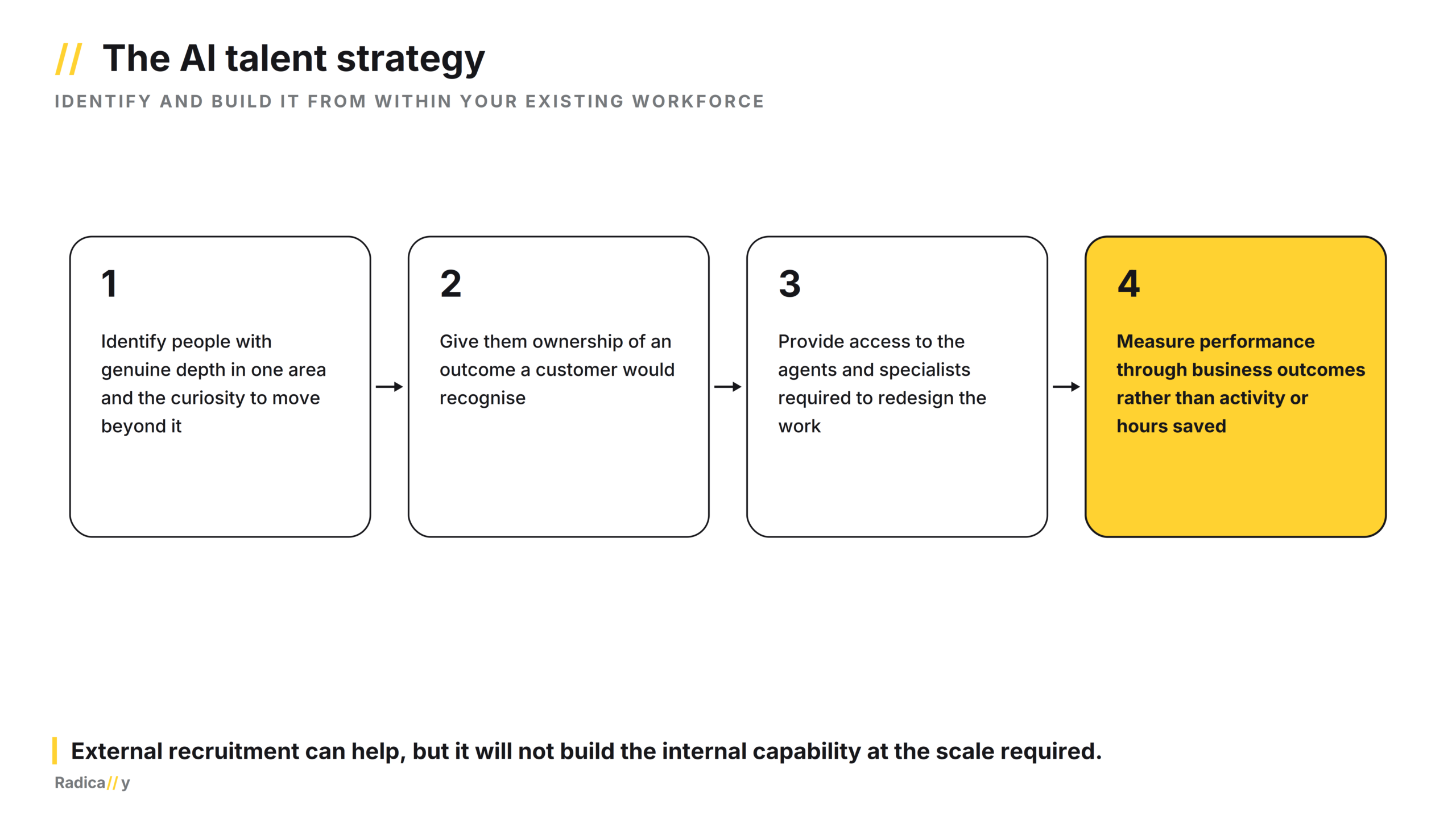
Proven expert generalists are rare, and as more organisations redesign work around AI, competition for them will increase. External recruitment can help but it will not build the internal capability at the scale required, organisations will need to identify and build it from within their existing workforce.
The starting point is to identify people with genuine depth in one area and the curiosity to move beyond it. Give them ownership of a meaningful customer or business outcome, along with access to the agents and specialists required to redesign the work around it. Measure their performance through business outcomes rather than activity or hours saved.
Hiring criteria must also change. Selecting people primarily based on the narrow requirements of an existing role will reinforce the same functional boundaries the new system of work needs to overcome.
The objective is not to replace every specialist with a generalist, but to develop enough expert generalists to connect specialists, direct agentic work and own outcomes across the organisation.
The AI Talent Strategy: What to look for, and what to grow
Research into the skills required for an AI-enabled workforce is beginning to reveal a consistent pattern. Employers still rank critical and creative thinking ahead of technical AI skills, yet many struggle to define the capabilities their people will need. Recent research into graduate readiness found that only 12% of employers rated graduates as excellent at evaluating AI outputs.
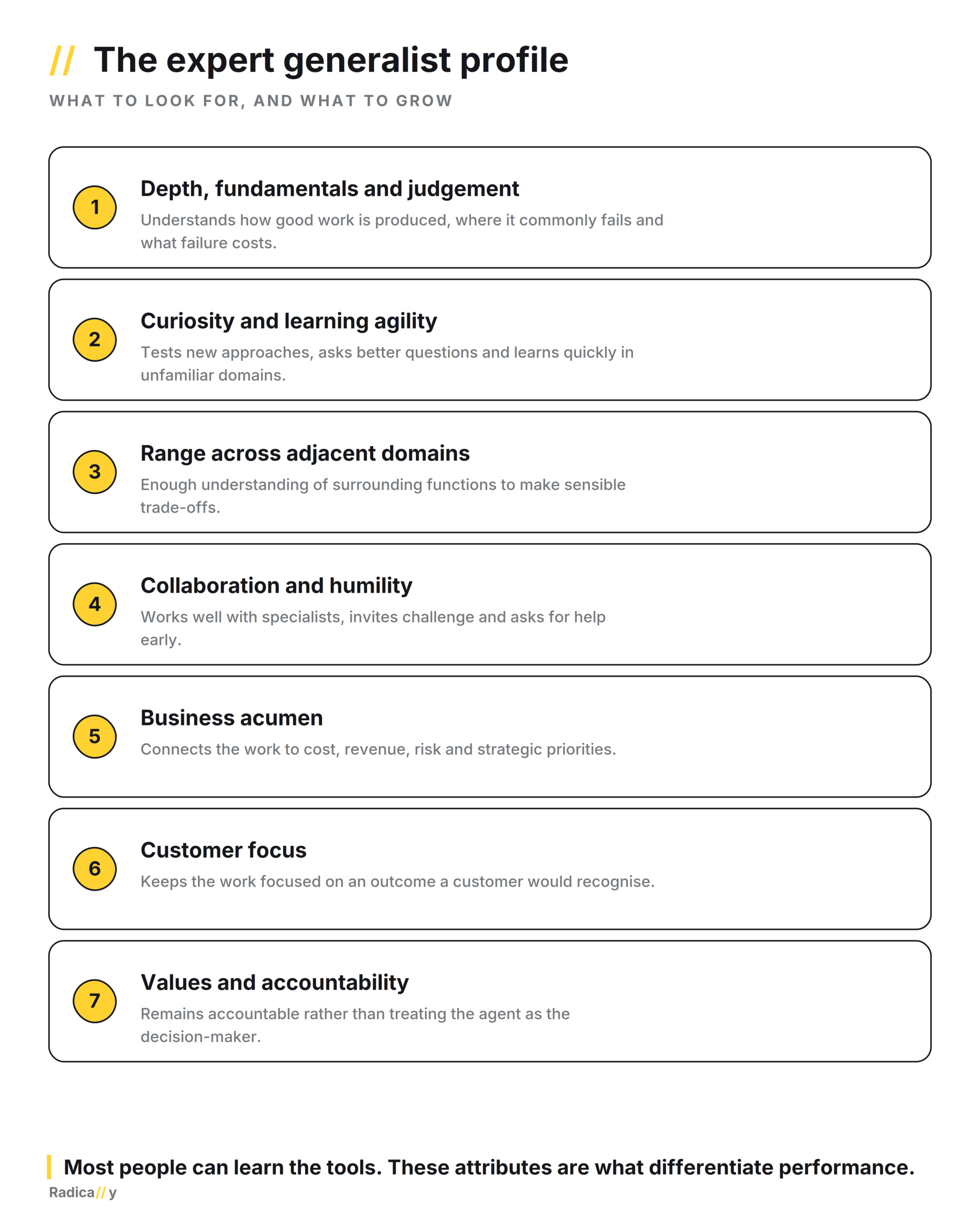
Most people can learn to use the tools, but far fewer can reliably judge the work those tools produce. As using AI becomes a standard part of work, what sets people apart will increasingly be the skills they bring to working with it. The following attributes provide a useful guide for both hiring new people and developing those already in the organisation:
- Depth, fundamentals and judgement: Expert generalists begin with deep expertise in at least one area. That experience gives them an understanding of how good work is produced, where it commonly fails and what the consequences of failure are. They can then apply that experience more broadly, making sound judgements in less familiar areas without needing to be an expert in every one.
- Curiosity and learning agility: The technology will continue to change, so people need to be willing to change with it. Curious people test new approaches, ask better questions and learn quickly as they move into unfamiliar domains.
- Range across adjacent domains: Expert generalists do not need to become specialists in every field, but they need enough understanding of the functions around their own to recognise constraints, make sensible trade-offs and know when deeper expertise is required.
- Collaboration and humility: Breadth does not mean having every answer. Expert generalists work well with specialists, invite challenge, and know when to ask for help. This becomes increasingly important as people spend more of their time navigating trust, relationships, and difficult decisions.
- Business acumen: Agents can produce a significant volume of output, but volume alone does not create value. The person directing the work still needs to connect it to cost, revenue, risk and strategic priorities
- Customer focus: Breadth needs a clear anchor. Expert generalists need to understand the outcome a customer would recognise and keep the work focused on delivering value.
- Values and accountability. One person may direct the output of many agents, amplifying their judgement and values across everything those agents produce. They must remain accountable for the outcome rather than treating the agent as the decision-maker.
Developing people for AI-Enabled organisations
The defining move on this ladder isn't the first step or the last. It's the leap from Level 3 to Level 4, and it’s the reason most organisations never realise a measurable ROI.
Twelve months ago, putting your first AI agent into production felt like the hard part. Today it isn’t. Most organisations have agents doing tasks, and many are connecting them to workflows. Reaching Levels 2 and 3 now brings parity rather than competitive advantage. The barrier has moved.
Crossing the wall requires organisational courage rather than technical courage. It means redesigning roles, reshaping how teams operate and asking leaders to lead mixed teams of people and AI agents. All of that is slower, harder and more uncomfortable than buying licences or connecting to another workflow. So most organisations quietly don't. They settle at Level 2, experiment at Level 3 and tell themselves the transformation is underway.
Everything before the wall is measured in hours saved. Everything beyond it is measured in business outcomes: tangible ROI, faster speed to customer, lower cost to serve, and improved margins.