

The gap between the organisations getting value from AI and those getting none has almost nothing to do with technology.
Walk into most organisations today, and you'll find AI everywhere. People are using it every day, licences have been rolled out across the business, and pilots are underway. By every visible measure, you're "doing AI."
Yet, when you look at the metrics that actually matter, cost to serve, speed to customer, margins and productivity, very little has changed.
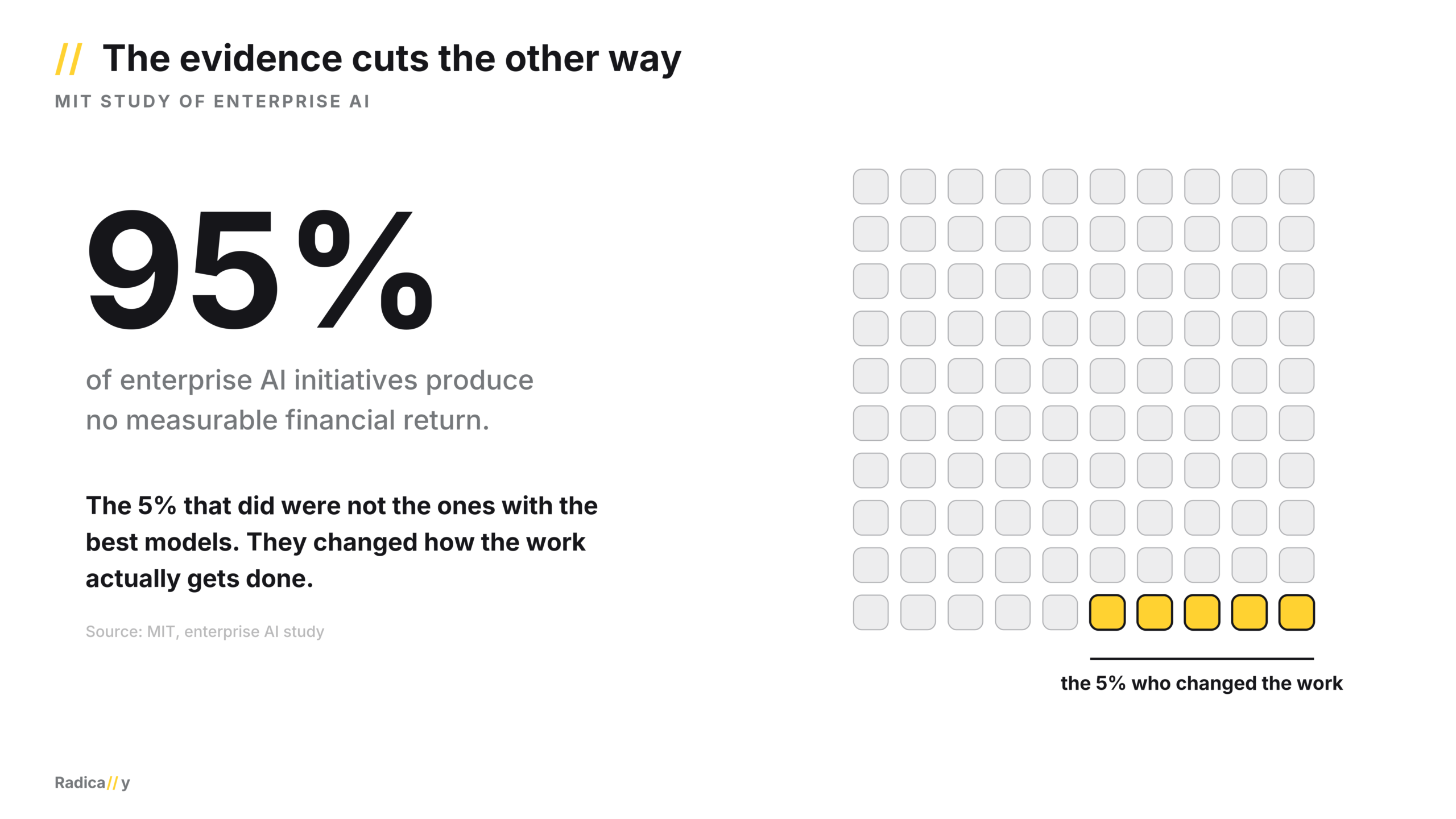
The instinct is to treat that as an early-days problem. Give it time, add a few more tools, and run another pilot. But the evidence points in a different direction. MIT's research into enterprise AI suggests that, despite tens of billions in spend, the vast majority of AI initiatives fail to produce any measurable financial returns. “95% of generative AI pilot programs in businesses fail to produce measurable financial impact”. The 5% who created value from AI were not the ones with the best AI models. They were the ones who redesigned how their work actually gets done.
Maturity isn’t a measure of your technology
AI maturity is not really a measure of the technology you’ve adopted; it’s a measure of how far your organisation has changed around it.
Most maturity models quietly measure your tech stack, what you've bought and what you've switched on. The maturity that actually predicts value measures something much harder and much more human. It looks at how far you've redesigned the system of work around what AI can now do, including the roles people play, the decisions they make, and the way they're led.
The organisations that win this era won't be the most technically sophisticated. They'll be the ones set up for humans and agents to work as one team.
The Five Levels of AI Maturity
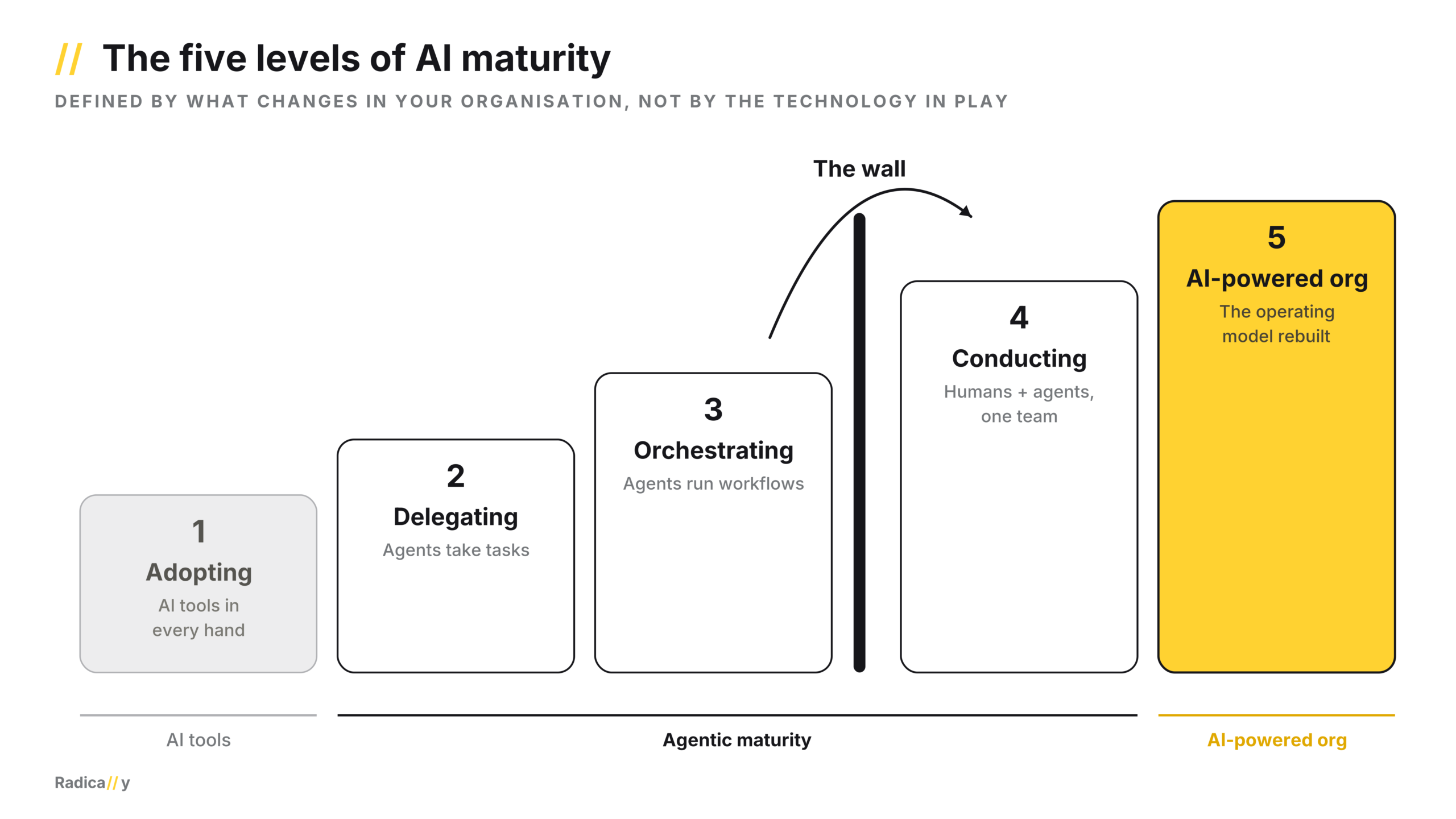
There are five levels we see in businesses today, defined not by the technology they use, but by what is actually changing across the organisation and for the people within it. There is also a “wall”, the hard boundary between using AI inside the existing organisation and redesigning the organisation around AI.
Level 1: Adopting -AI tools in every hand
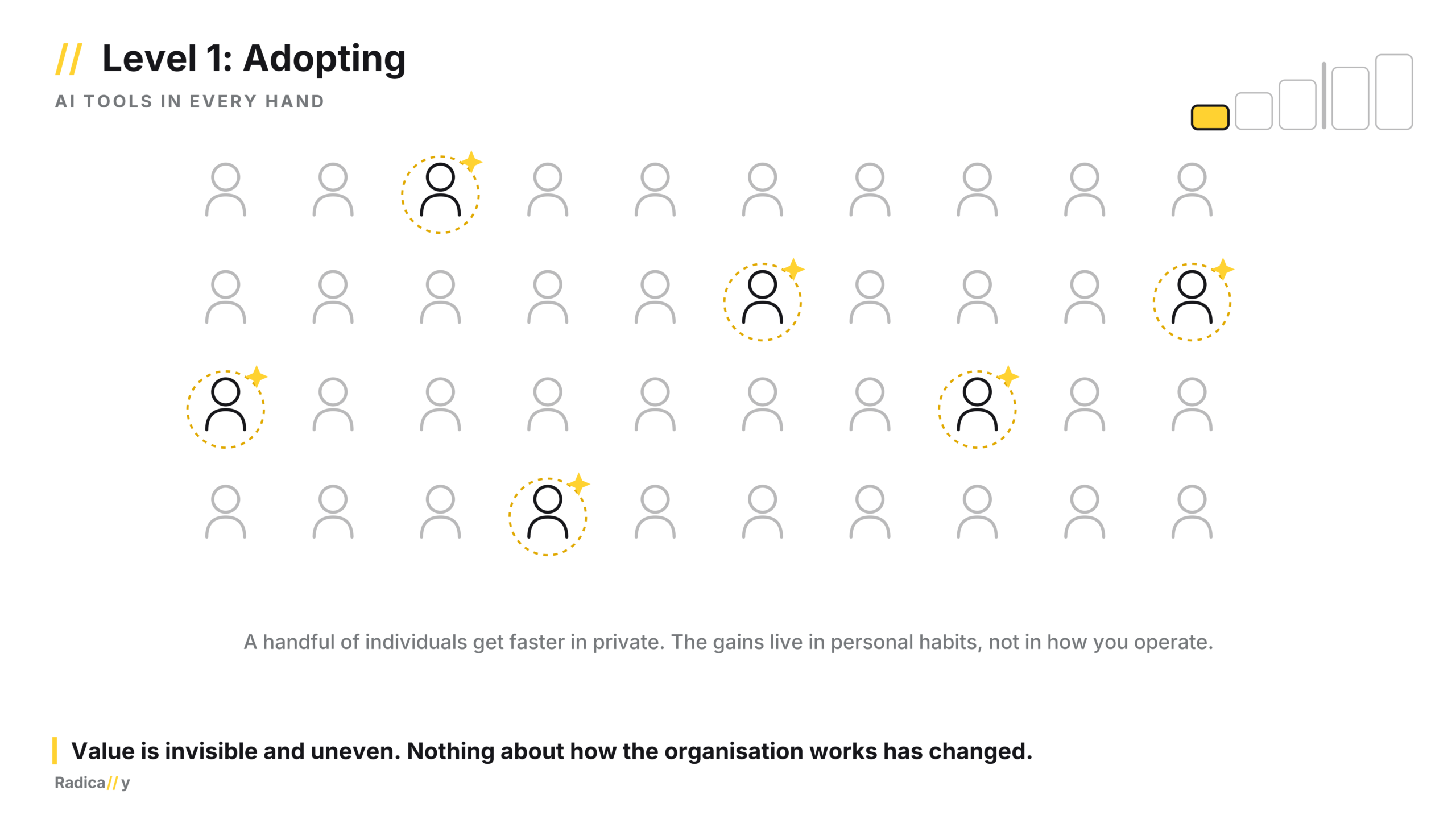
What’s happening: People find AI on their own. Some use it to draft emails, others to summarise documents, and a few quietly lean on it for real work without mentioning it. Eventually you make it official by rolling out licences and providing training with the message to use AI to work faster. People then apply it to the tasks they already do, and those tasks get done a little quicker.
What it means for your organisation: The value is invisible and uneven, with pockets of productivity you can't see and risk that remains hidden. Nothing about the way the organisation works has changed. A handful of individuals are simply working faster in private, but none of the gains are really yours. They exist in people's personal habits, not in the way the organisation operates.
Level 2: Delegating - Your first agents in production
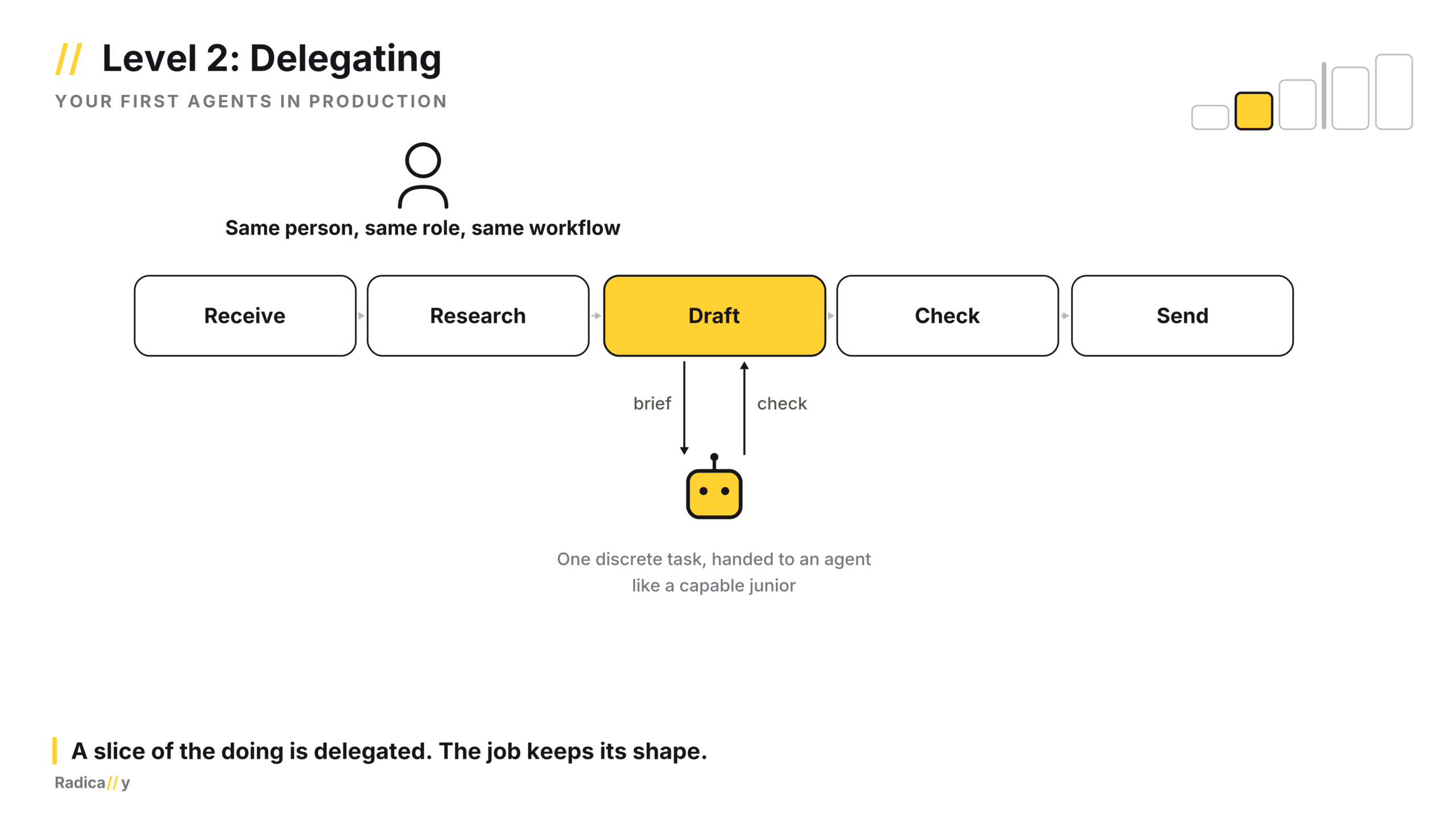
What’s happening: People start handing discrete tasks to agents in much the same way they would to a capable junior colleague. An agent might draft the compliance summary, resolve simple IT tickets, or answer the questions that would have previously queued behind a centre of excellence. The person still owns the task. They brief the agent, review the output, and send it on.
What it means for your organisation: The job itself hasn’t changed. The same people hold the same roles, with the same accountabilities in the same workflows. A portion of the work has been delegated, so tasks are completed in hours rather than days, and scarce expertise stops being a bottleneck. The value is real, and people get their first taste of directing and reviewing an agent's work rather than doing everything themselves. But the work itself has kept its shape. This is where most organisations are today.
Level 3: Orchestrating. One person, many agents
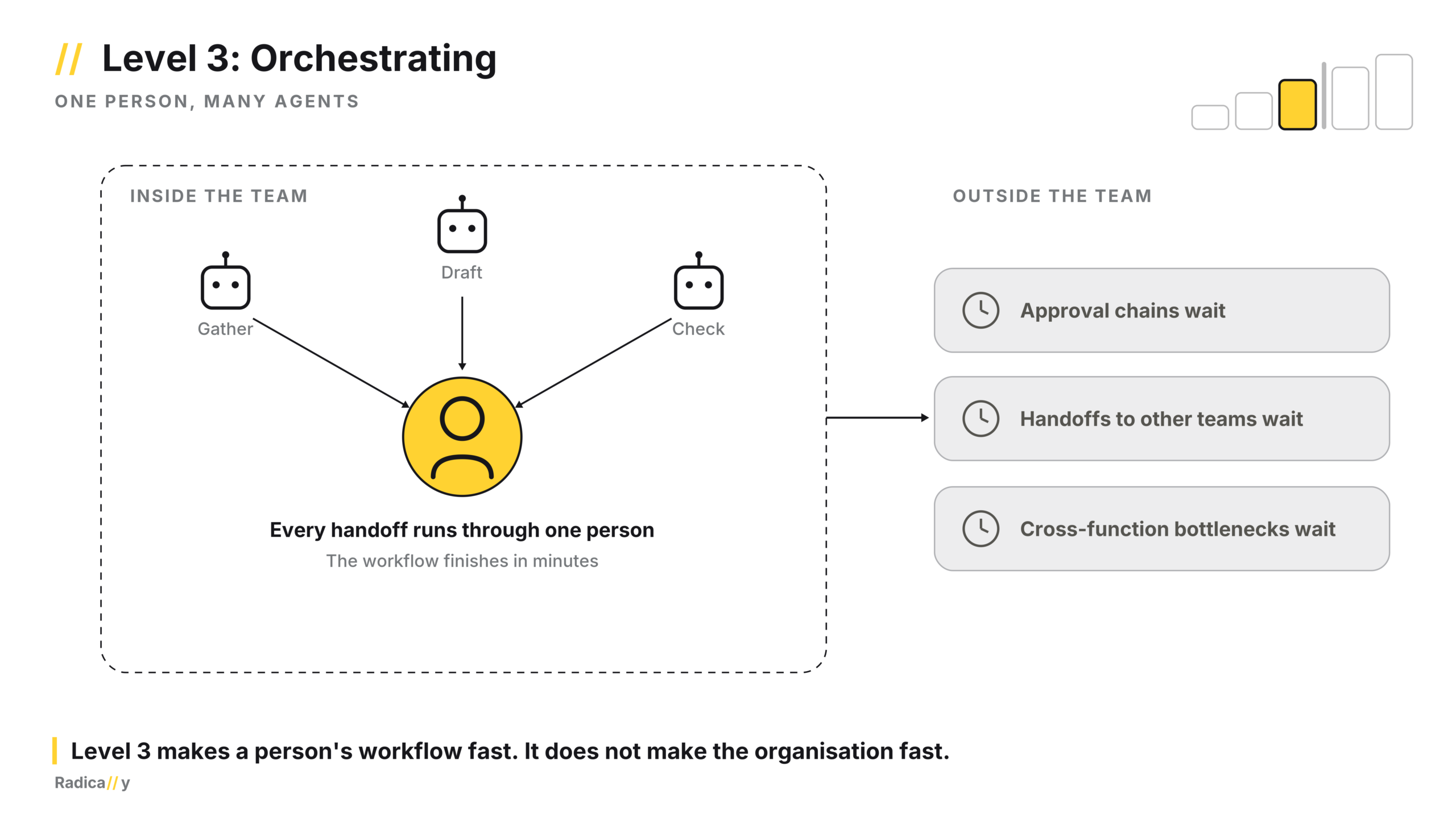
What’s happening: A person now coordinates several AI agents across a workflow, routing work between them. One agent gathers, another drafts and another reviews. The person orchestrates the sequence, deciding which agent does what and when the output is ready to move forward.
What it means for your organisation: This is where work begins to change, but the person’s role stays the same, just with more hands. They still own the workflow, and every handoff runs through them.
Within the team, the impact is significant. Work that took days now completes in hours. But step outside the team and nothing has changed. Approval chains, the handoffs to other teams and bottlenecks between functions remain exactly where they were. The workflow finishes in minutes, only to wait for the rest of the organisation. The time saved quietly dissolves into inboxes and meetings because nobody has redesigned the roles and the way work flows.
Level 3 creates faster workflows at an individual/team level, but it does not create a faster organisation.
THE wall
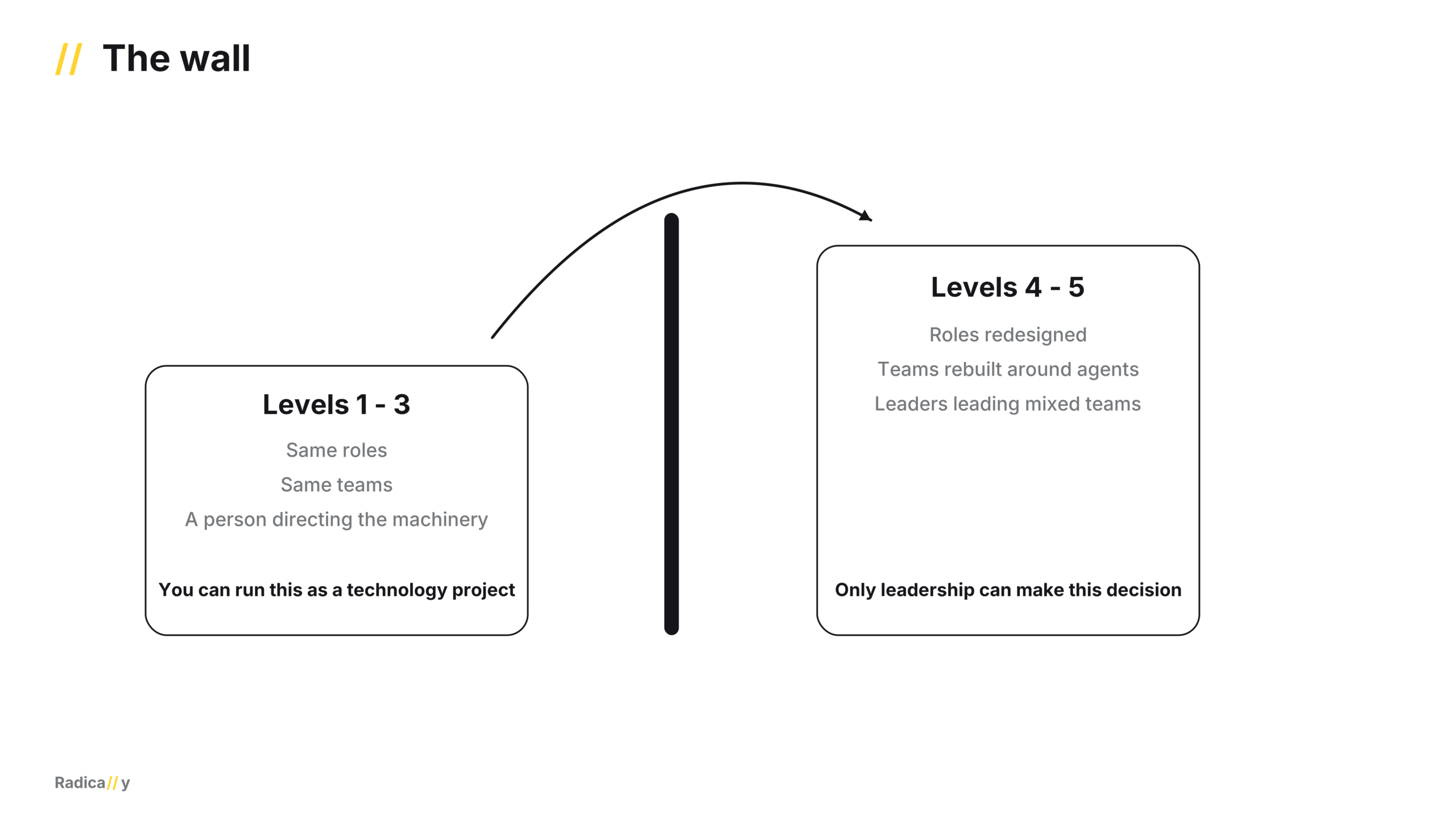
This is the point on the ladder that changes everything, and it’s where most organisations will stall.
Up to this point, everything has happened inside your existing structure, with the same roles, the same teams, and a person at the centre directing the machinery. That’s why Levels 1 to 3 can be delivered as technology projects. Level 4 is different, because it requires you to redesign the team itself, and that’s a decision only leaders can make. It is the first level you cannot buy.
Crossing the wall doesn't start with a transformation programme. It starts with one team and one workflow.
Pick a piece of work that matters, one with a clear beginning and an end a customer would recognise, and give a single team end-to-end ownership of it. Chances are no team owns it today, and that's exactly the point.
Redesign the roles, handoffs and operating cadence around humans and agents working together. Measure the result in business outcomes, not hours saved.
One team operating at Level 4 will do more for your organisation than a hundred AI pilots. It proves the new way of working can succeed in your business, with your people, and gives the rest of the organisation something tangible to replicate and learn from
Level 4: Conducting. Humans and agents teams
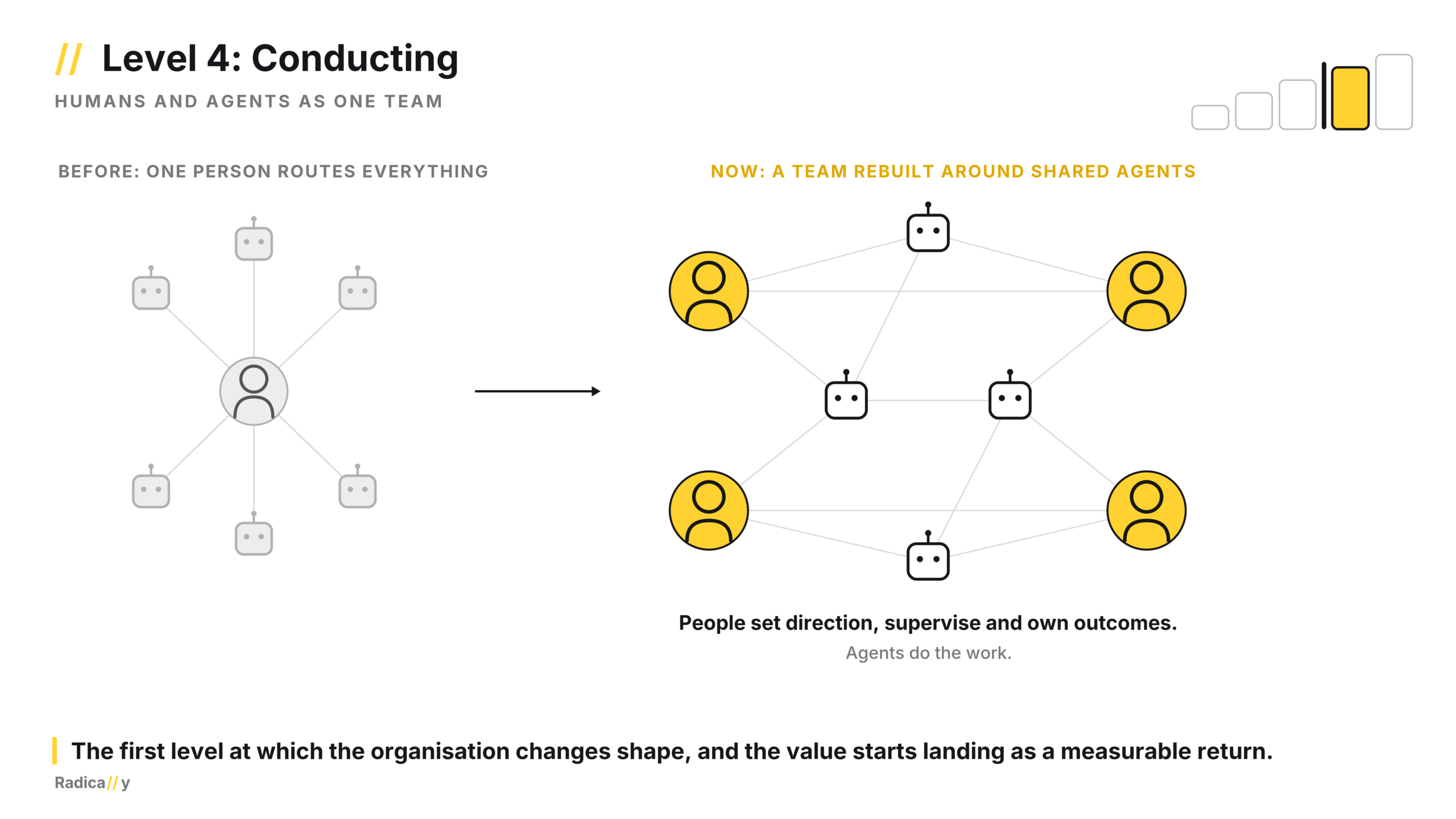
What’s happening: Agents are no longer coordinated manually because the team has been redesigned around them. Shared agents become embedded within the system of work. Roles, handoffs, feedback loops and cadence are all redesigned so that people and agents deliver value, end-to-end, together.
What it means for your organisation: This is where maturity stops being about technology and starts becoming about your people. The team's operating model is rebuilt around humans and agents, with people setting direction, supervising and owning outcomes while agents carry the routine cognitive work. As a result, roles begin to evolve. New ones emerge, others become broader or more specialised, and some disappear altogether. Handoffs that once took days disappear, and the work someone used to do themselves becomes work they direct and quality-control.
People are freed up to do the genuinely human parts of the job: judgement, relationships, and managing exceptions. None of this works through the process alone. It depends on trust, accountability, culture, and leaders who build foundations deliberately, making the shift energising rather than threatening for their people. This is the first level at which your organisation has genuinely changed shape, and the first at which AI starts to reliably deliver value in a measurable return.
Level 5: The AI-powered organisation
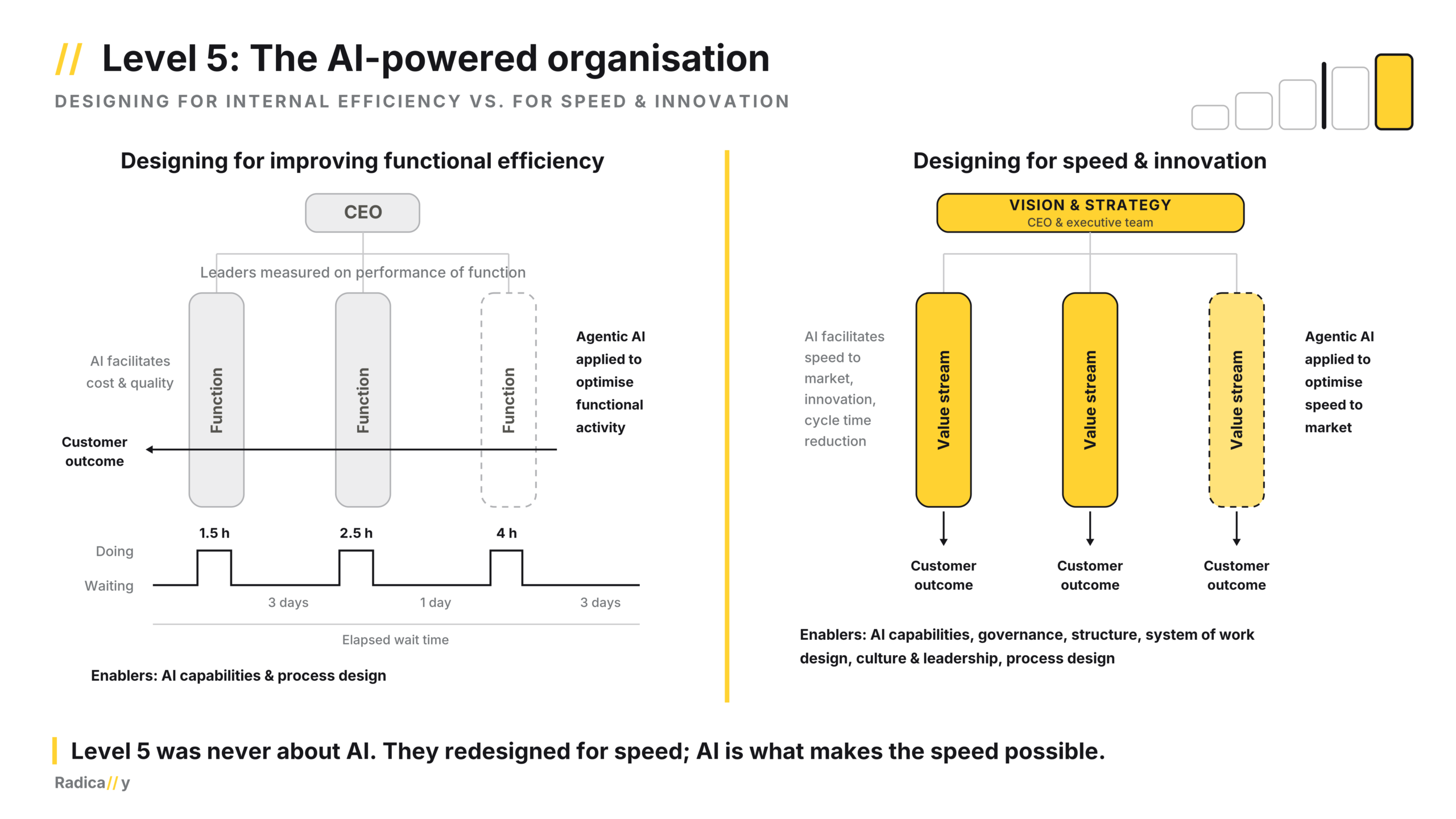
What’s happening: The changes introduced at Level 4 scale across the wider organisation. The space between teams and divisions collapses, allowing decisions, funding, approvals and work to flow across the business without unnecessary handoffs. The transformation reaches the executive level too. Leaders now work with agents on strategy and organisational oversight end-to-end, with scenarios modelled, options pressure-tested and performance monitored across the business in real time. This allows leaders to focus their attention on judgement calls and decision-making, rather than on assembling the picture.
What it means for your organisation: Here’s what most organisations get wrong about this level. It was never really about AI. Organisations at Level 5 didn’t redesign themselves for the technology; they redesigned themselves for speed, and AI is what makes that speed possible.
Consider what actually constrains your organisation today. It isn’t a shortage of information or effort. It’s the time everything takes; the decision that waits three weeks for a committee, the customer insight that takes a month to reach the people who could act on it, and the handoffs that turn a two-day task into a two-week one.
Those delays aren’t caused by people being slow. They’re caused by structure, by an operating model designed for a world where humans had to carry every step.
Level 5 organisations have removed that constraint, so decisions that took weeks now take days. They sense what’s happening in their market, and respond while competitors are still scheduling the meeting to discuss it.
That speed compounds because every cycle they learn faster, adjust faster and pull further ahead. The technology will continue to evolve beneath them, but it won’t matter. What they’ve built isn’t an AI capability, it’s an organisation that can move at the pace the technology allows, whatever that technology becomes.
Why most organisations stop at the wall
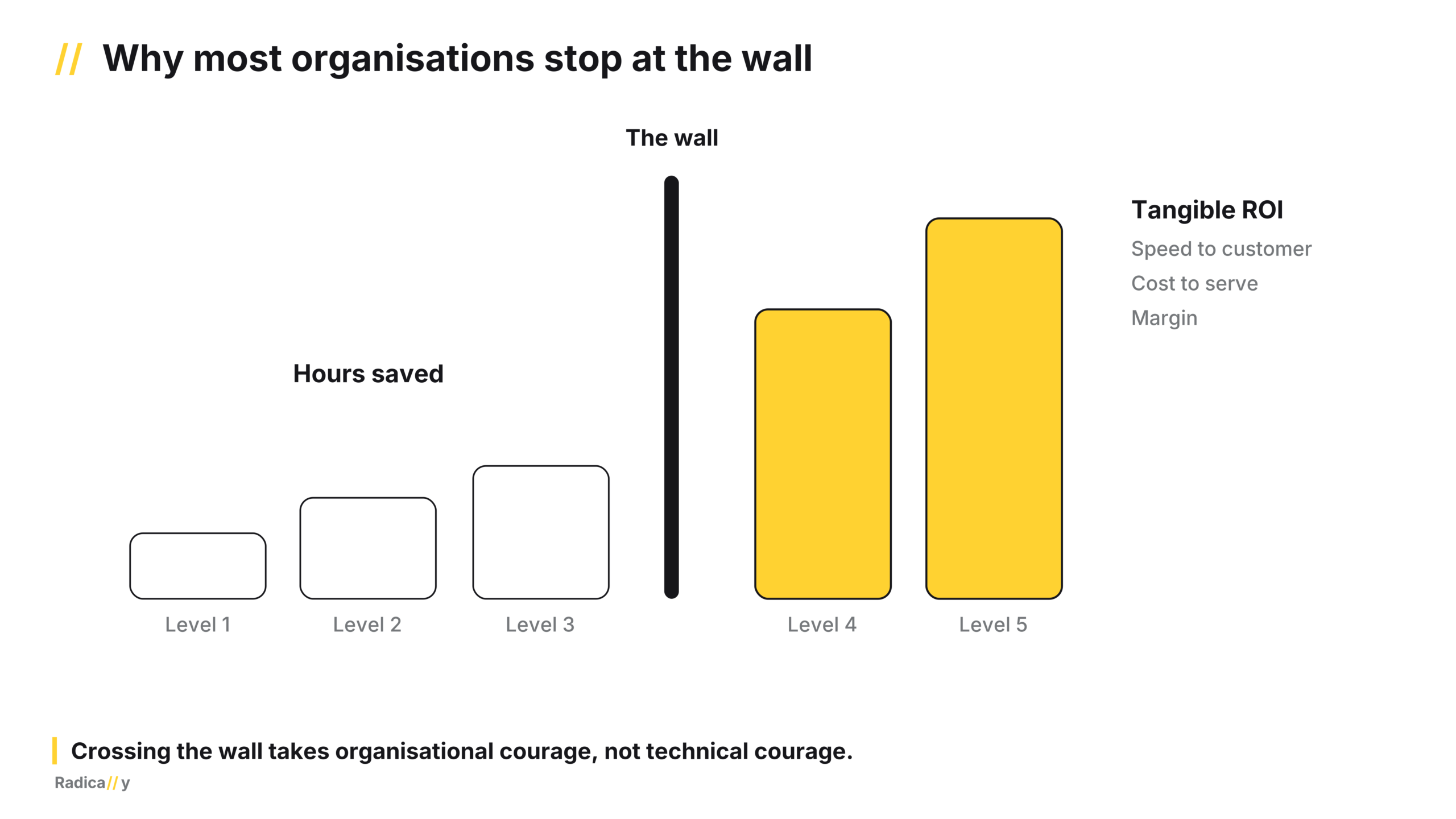
The defining move on this ladder isn't the first step or the last. It's the leap from Level 3 to Level 4, and it’s the reason most organisations never realise a measurable ROI.
Twelve months ago, putting your first AI agent into production felt like the hard part. Today it isn’t. Most organisations have agents doing tasks, and many are connecting them to workflows. Reaching Levels 2 and 3 now brings parity rather than competitive advantage. The barrier has moved.
Crossing the wall requires organisational courage rather than technical courage. It means redesigning roles, reshaping how teams operate and asking leaders to lead mixed teams of people and AI agents. All of that is slower, harder and more uncomfortable than buying licences or connecting to another workflow. So most organisations quietly don't. They settle at Level 2, experiment at Level 3 and tell themselves the transformation is underway.
Everything before the wall is measured in hours saved. Everything beyond it is measured in business outcomes: tangible ROI, faster speed to customer, lower cost to serve, and improved margins.
How to tell which level you’re really on
- If you switched off every AI tool tomorrow, would any work actually stop, or would people simply revert to the old way a little slower? If it's the latter, you're at Level 1
- Is any agent in production carrying out real work, briefed and checked by a person? That's Level 2.
- Is someone coordinating multiple AI agents across an entire workflow, deciding which agent does what and when the output moves forward? That's Level 3.
- Has any role genuinely changed shape, not "now uses AI", but with different accountabilities, in a team redesigned around agents? That’s Level 4.
- Does work move between teams without waiting on handoffs? And does your executive team work alongside AI agents on strategy and organisational oversight? That's Level 5.
Finding the gap between the maturity you believe you have and the maturity you actually have is the single most useful insight into your AI position.
The real choice
The temptation in a fast-moving field is to believe the answer is always more technology, whether that's a newer model, a bigger rollout or the next pilot. The evidence cuts the other way.
In the end, AI maturity isn't something you buy. It's something you build, through the choices you make, and the way you lead your organisation through them.